
Get Up and Walk · Week 4 · Tuesday
The Knock
He lost his temper at his sixteen-year-old yesterday.
It was not a big thing, as these things go. The kid had left the garage door open overnight again, after being asked three times that week to check it. The dad came down hard. Louder than an open garage door deserves. He said something about responsibility and being sick of repeating himself, and there was an edge in his voice that was not really about the garage door at all. It was about the meeting that had gone badly that afternoon. It was about the email he was dreading. The garage door was just the thing that was standing there when the pressure found a release.
The garage door was just the thing that was standing there.
His son went quiet. He did not argue. He just absorbed it, said okay, and went up to his room. The dad told himself the kid needed to learn responsibility. He let it sit overnight.
The Next Morning
This morning the dad is in the kitchen making coffee, and he knows.
He knows the edge in his voice was not about the garage door. He knows his son felt the unfairness of it, the way kids always feel the exact size of an overreaction even when they cannot name it. He knows his son is upstairs carrying something that is two sizes too big for what he actually did.
And he knows what the older men in his own life would have told him. A man does not apologize to a teenager for using a sharp tone. It undermines authority. The kid should have closed the garage. Let him learn that actions have consequences, including the consequence of dad being irritated. Do not make a thing of it.
He stands at the coffee maker and decides those men were wrong about this.
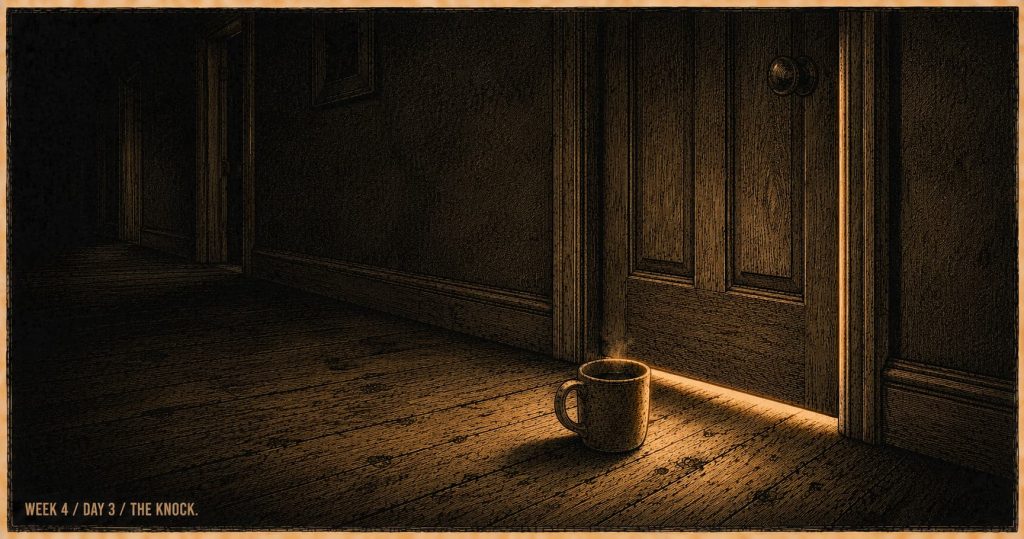
He pours a second cup. He carries it upstairs. He sets it on the floor outside his son’s closed door. And he knocks.
Biblical Backdrop
In the letter Paul sent back with Onesimus, there is a sentence where Paul does something remarkable. He offers to personally absorb whatever Onesimus owes.
This is accounting language. Paul is using the vocabulary of a ledger. Whatever debt is on Onesimus’s side of the books, the stolen money, the lost labor, the cost of the wrong, Paul says: move it to my column. I will cover it. Do not make the reconciliation contingent on him paying it down first. I will take the debt so the relationship can be restored now.
That is what a father does. Not “you owe me an apology and once you have groveled sufficiently we can move on.” A father who has wronged a son takes the debt onto his own account. He goes first. He absorbs the cost of the repair rather than making the child pay for the parent’s mistake.
What Happened at the Door
His son opens the door, braced for round two. His face is still for it.
The dad hands him the coffee. He says, “I came down harder than you had coming yesterday. The tone was about my day, not about your garage door. That was not fair to you, and I am sorry.”
His son blinks. He was not braced for this. He says, “It’s okay, Dad.”
The dad says, “It wasn’t okay, but thank you for saying that. The garage thing still needs to get handled, and we will. But the way I talked to you, that one is on my account, not yours. I owed you that.”
Then he goes back downstairs and lets his son drink his coffee.
The walk back was a flight of stairs and a cup of coffee, delivered the morning after, before the thing could calcify into one more entry on the long list a son keeps of the times his father was unfair and never came back to fix it. The dad took the debt onto his own account. He went first.
The walk back is the work.
Tomorrow · Charge It to My Account
Leave a Reply