
Get Up and Walk · Week 4 · Wednesday
Charge It to My Account
Six months ago he let a colleague take the blame for something that was half his fault.
A project missed a major deadline. In the meeting where it all came apart, a younger colleague got named as the reason it had slipped. And the younger colleague had made a real mistake, that part was true and everyone could see it. But the bigger reason the project failed was a call the older man had made weeks earlier, a quiet decision about scope that nobody else in the room knew he had made. He could have spoken up in that meeting. He could have said, “The mistake you are looking at is downstream of a call I made, and I should own that.”
He stayed quiet.
He could have spoken up. He stayed quiet.
The younger colleague absorbed it. Took the hit on the next performance review. The older man kept his record clean and told himself the younger colleague’s mistake was real, which it was, which made the silence easier to live with.
Six Months of Knowing
He has carried it for six months. He watches the younger colleague get passed over for the assignments that would help a career, and he knows part of the reason why, and the younger colleague does not. He has told himself the usual things. It would be weird to bring it up now. The moment has passed. Stirring it up would only make things awkward for everyone. People have moved on.
But he knows the younger colleague has not moved on. You do not move on from a hit to your record that you did not fully earn. You just learn to carry it quietly, the way the older man is now carrying his own version of the same weight.
Two people are carrying the same lie. One of them knows it is a lie. That one is the only one who can end it.
Biblical Backdrop
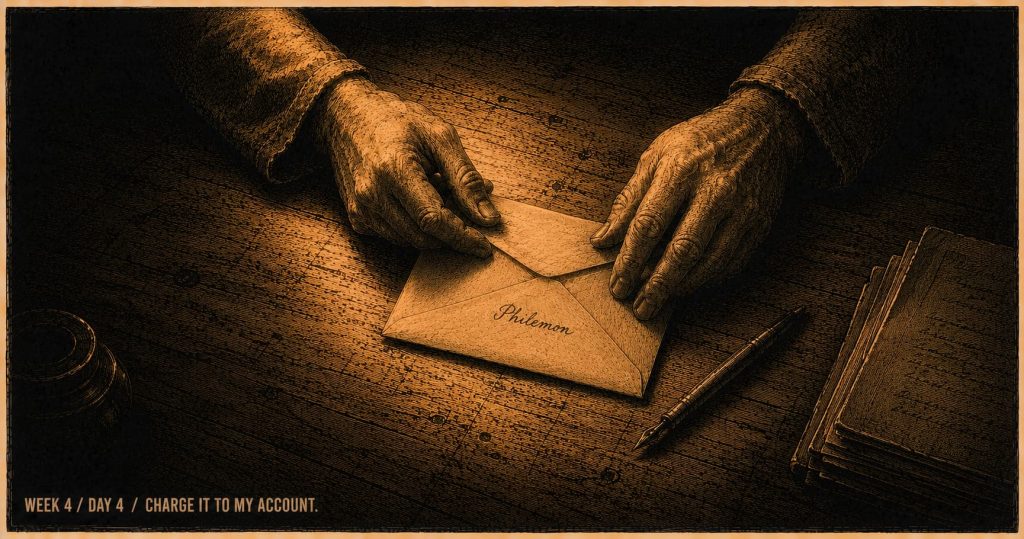
The whole letter of Philemon is built on Paul putting himself between two people so that a relationship can be made right. In verse 17, Paul makes the move explicit.
The Greek for “partner” is koinōnos, from koinōnia, the word for deep fellowship and shared life. Paul is saying: you and I share everything, Philemon. So apply that partnership to Onesimus. Whatever credit I have with you, spend it on him. Whatever standing I have, transfer it to his account. Receive him as you would receive me.
Paul is willing to put his own reputation on the line, to spend his own standing, so that a wrong can be made right and a relationship restored. He does not protect his position. He pledges it. That is what reconciliation costs the person who has the power in the situation. It costs them their clean record. It costs them their advantage.
What It Cost Him
This week the older man does the thing that costs him. He requests a meeting with his own manager. He does not soften it into a vague “I think the post-mortem was incomplete.” He says it plainly. The failure six months ago was substantially the result of a scope call he made, not the younger colleague’s mistake, and the record should reflect that. He puts it in writing. He sends it to the manager and copies the younger colleague directly so there is no version of this that stays in the shadows.
It costs him. His manager’s view of him takes a real hit, the kind that does not fully heal. He gets a reputation, fairly, as someone who made a quiet call and let someone else carry it for half a year. That is the honest cost of the honest correction, and he pays it.
But the ledger is finally honest. The younger colleague reads the email and stops by his desk and does not know what to say, and neither of them really does, and that is okay. The debt got moved to the right account. The walk back is the work.
Tomorrow · Leave the Gift at the Altar
Leave a Reply