
Get Up and Walk · Week 4 · Monday
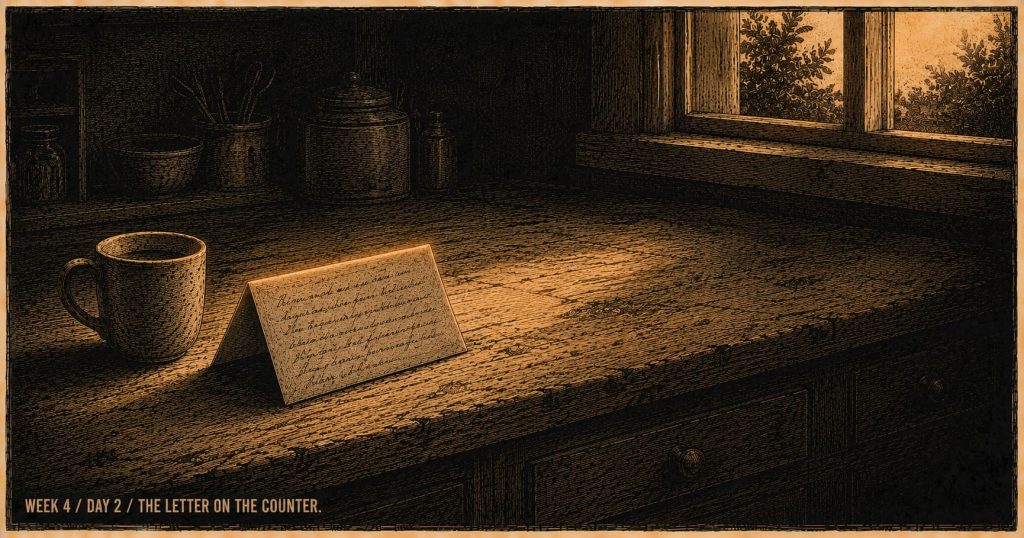
The Letter on the Counter
Fifteen years ago he said something cutting to his wife in front of her parents.
He barely remembers the fight that led up to it. He remembers the sentence. So does she. It was the kind of sentence that takes a person’s deepest insecurity and says it out loud, in front of the people whose opinion she cares about most. He saw her face change in the moment he said it. He has never forgotten her face changing.
He has never forgotten her face changing.
They moved past it. That is the phrase people use. They moved past it. They did not talk about it again. They went home that night and were cold to each other and then, over a few days, the cold thawed and life resumed and the sentence went underground.
But it did not leave. For fifteen years, every time her parents come up in conversation, he watches a small flinch cross her face. A flicker. Most people would not catch it. He catches it because he put it there. He buried the sentence, but he never went back for it. He told himself burying was the same as healing. It is not.
This Week He Goes Back
This week, for reasons he could not fully explain, he decides to go back for it.
He knows himself well enough to know the danger. If he tries to bring it up cold, over dinner, he will get three sentences in, feel the discomfort, and either trail off into a vague non-apology or get defensive and turn it into a discussion of something she did. He has watched himself do exactly that with smaller things. So he does something he has never done before.
He writes it out first.
On paper. In his own handwriting. The specific sentence he said fifteen years ago, written out word for word so he cannot soften it. The specific wrong of it, named plainly. No excuse attached. No “but you had also said.” No explanation of the stress he was under. Just the naming of the exact thing, and the ownership of it, and the request to be forgiven for that specific sentence on that specific night.
He leaves the letter folded on the kitchen counter where she will find it after work. Then he waits in the next room, feeling like he might be sick.
Biblical Backdrop
When Paul sent Onesimus back to Philemon, he sent the letter with him. And in the letter, Paul wrote one of the most tender lines in all of his writing about what he was doing.
The Greek for “my very heart” is splanchna. It does not mean the heart as we use the word, the seat of warm feeling. It means the inward parts, the guts, the viscera. In Greek anthropology the splanchna were the deepest seat of a person’s affection and compassion, deeper than the heart. When Paul says he is sending his splanchna, he means he is sending the most vulnerable, interior part of himself out onto a dangerous road.
Reconciliation always costs you your splanchna. It always means sending the soft interior part of yourself out into a situation where it could be crushed. There is no way to walk back toward someone you wronged while keeping your guts safe. The walk back requires the soft part to be exposed.
What She Found
She reads the letter at the counter. He hears her stop moving in the kitchen. After a few minutes she comes and finds him in the next room. She is crying, but not the way he had feared. Not the old hurt reopening. Something else.
She says, “I have been waiting fifteen years for you to know that mattered.”
Not waiting for the apology, exactly. Waiting for him to know. Waiting for the evidence that he had seen her face change that night the same way she had felt it change. The letter was not the healing. The letter was the proof that he had been carrying it too, that it had not been invisible to him all this time, that the thing she had felt alone in for fifteen years he had also been holding.
The walk back was not a feeling. It was a specific sentence, named and owned, written in his own hand, fifteen years late and still not too late.
The walk back is the work.
Tomorrow · The Knock
Leave a Reply