
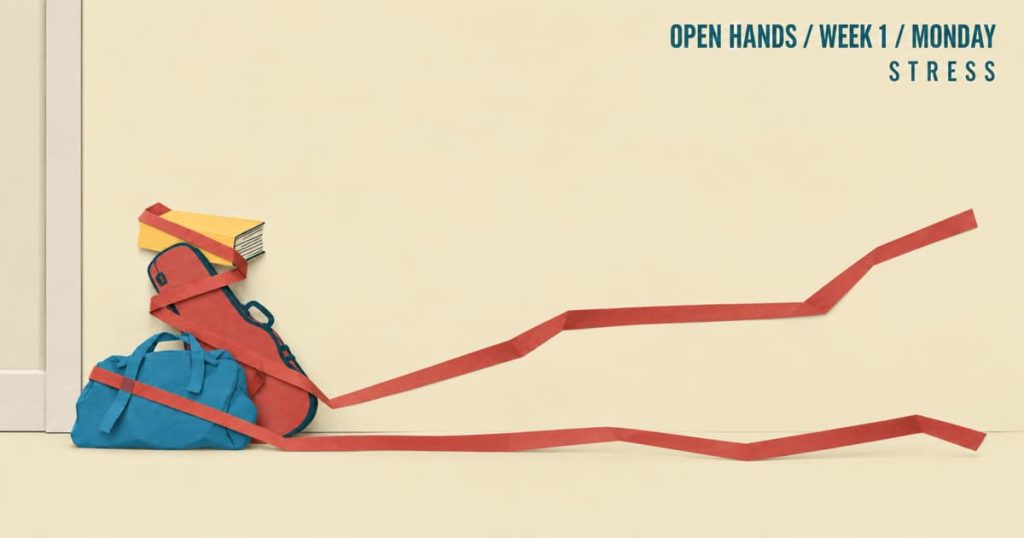
Open Hands · Week 1 · Monday · STRESS
She is sixteen. She found out on a Tuesday that her friend got the spot she had wanted since ninth grade, and by Thursday she had signed up for a fourth activity.
Not because she wanted the fourth activity. She could not have told you much about it. She signed up because on Tuesday the list had three things on it and three things had turned out not to be enough.
Nobody made her do it. That is the part that is hardest to explain to a parent standing in the kitchen asking who is pressuring her. There was no pressure in the room. The pressure was a number she had been quietly running in her head against somebody else’s number, and the only lever she could reach was to add.
We do not dare to classify or compare ourselves with some who commend themselves. When they measure themselves by themselves and compare themselves with themselves, they show their ignorance.2 Corinthians 10:12 (BSB)
Not Sin. Ignorance.
Notice what Paul does not call this. He does not call it sin, or pride, or weakness. He calls it ignorance — not knowing what you are doing.
And he is right, because a number measured against another person’s number tells you nothing at all. It cannot tell you what you were given. It cannot tell you what this season is for. It can only ever tell you whether you are ahead or behind of someone whose life you are not living.
She was not lazy. She was not unmotivated. She was doing the thing that looks most like diligence from the outside and is actually the opposite of trust.
Three was not enough because three had lost.
What It Cost
The turn did not come in a dramatic moment. It came on a Sunday afternoon when she said it out loud to her mother, in the car, not looking at her: I don’t want any of this. I just didn’t want to be the one who got passed over.
Saying it was the whole thing. It went from a number running silently in her head to a sentence in a room with another person in it, and a sentence can be argued with.
She dropped the fourth thing. Then, a week later, she dropped a second one — and here is where it actually cost something. The one she dropped was the thing she was best at. Three years in, genuinely good, a real future in it if she wanted one. She kept the two she was doing for a reason and let go of the one she had been doing to prove something.
Her mother cried. She did not.
Comparison always answers the question it was asked. Ask it how you measure up and it will tell you, forever, and the answer will never once be enough. It is not built to say enough. It is built to keep score, and a scoreboard has no way of knowing what you were assigned.
She has a Thursday evening free now for the first time since she was thirteen. She says it still feels like she is getting away with something.
Leave a Reply