
Rooted / Week 4 / Our Trials
What He Is Willing to Spend
And the surviving remnant of the house of Judah shall again take root downward and bear fruit upward.— Isaiah 37:31 (ESV)
A couple in their fifties sat in a hospital parking lot with the engine off. They had just been handed a word about her scans that they did not have a category for. Neither of them said anything for a long time.
The question sitting in the car with them was not whether God exists. They had settled that decades earlier. The question was whether He is good, and whether He was paying attention that morning.
Nothing got fixed in that parking lot. No verse arrived on cue. What arrived was a steadiness neither of them could account for, and a sentence her husband finally said out loud with his hands still on the wheel. I do not think He is going to explain this to us.
They walked back in. They kept walking back in for fourteen months. The marriage they have now is not the marriage they had before, and neither of them would trade it back.
Here is the part we do not say from a stage very often. God allows hard things. Not just inconvenient things. Sometimes devastating things. He is not surprised by them, He is not absent in them, and He does not waste them.
Hebrews says it without flinching. He disciplines us for our good, that we may share his holiness. For the moment all discipline seems painful rather than pleasant, but later it yields the peaceful fruit of righteousness to those who have been trained by it. (Hebrews 12:10-11, ESV) Sanctification is the word for that process. It means God is making us holy, and He is willing to spend our comfort to do it.
Solomon looked at everything a man can build in a lifetime and called it a striving after wind. (Ecclesiastes 1:14, ESV) James was shorter about it. We are a mist that appears for a little time and then vanishes. (James 4:14, ESV) That is not despair. That is proportion. If these years were all we had, a diagnosis would be theft and nothing else. But they are not all we have. God is building something in us that will outlast the body it is being built in.
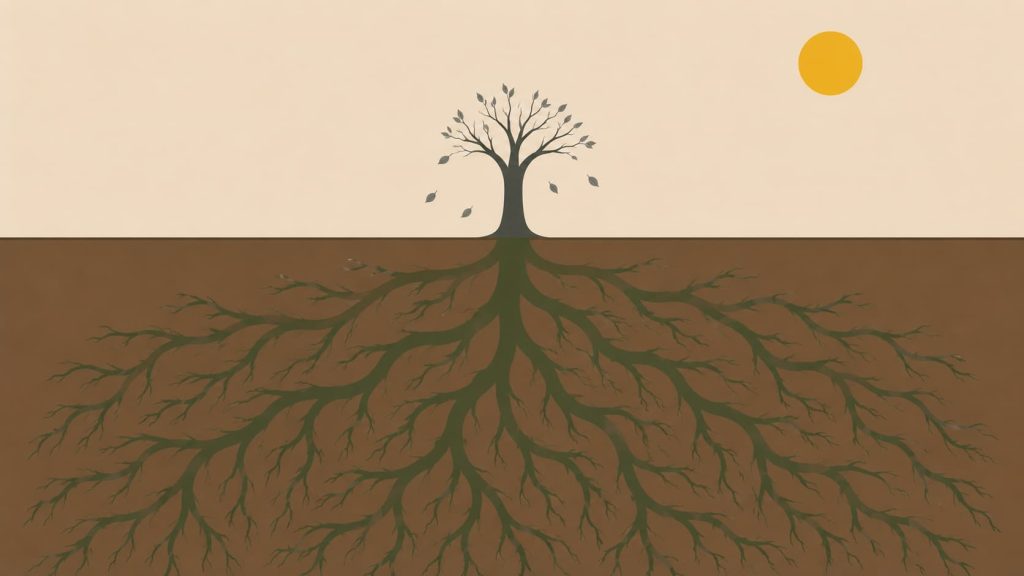
Isaiah described the survivors this way. They take root downward and bear fruit upward. Downward comes first. It always comes first. Roots do not grow deep in an easy season. They grow when the ground goes hard and the water goes deep and there is no option left but to reach.
Jesus showed us the other outcome in the parable of the sower. When the sun rose they were scorched, and since they had no root, they withered away. (Matthew 13:6, ESV) Same sun. Different root system.
This does not mean every hard thing comes with a tidy lesson attached. Some of it we will not understand on this side of eternity. It means none of it is loose. He is holding all of it.
Joy is not happiness. Joy is the power to endure adversity, and it fills us with hope. It is not the feeling that this is fine. It is the settled certainty that this is not the end, and that the One who allowed it is not careless with it.
In the Original
The word translated discipline in Hebrews 12:10 is paideia. It comes from the pais root, the Greek word for child, and Greek grammars point out that the same root gives us pedagogy and paideutics, the art of teaching. A child in that word is defined as one who learns, one who needs to be taught.
Paideia is not punishment. It is the entire process of forming a child into an adult, which includes instruction, correction, hardship, and time. A father who paideias his son is not settling a score. He is building someone.
On the other side of the canon is hebel, the word Solomon uses in Ecclesiastes. It appears 73 times in the Old Testament and 38 of those are in Ecclesiastes alone. It means vanity, futility, and literally breath.
Most of us hear meaningless. Solomon said vapor. Not worthless, brief. You can see your breath on a cold morning and then you cannot. That is his word for everything we build here, said 38 times in one book, and he was not despairing when he said it. He was measuring.
What Gets Diluted
Two opposite dilutions are on offer, and both of them are easier than what Scripture actually says.
One says God only ever wants us comfortable, so suffering means something went wrong. Somebody lacked faith, somebody claimed the wrong thing, somebody missed a step. This one is popular because it leaves us in charge.
The other says suffering is simply random, the universe is indifferent, and meaning is whatever we assign it afterward. This one is popular because it asks nothing of us.
Hebrews takes neither. It says the hard thing is a Father forming a child, it admits the process is painful rather than pleasant, and it refuses to pretend otherwise. It does not promise an explanation. It promises a purpose, and those are not the same gift.
If we are in a hard season right now, the question is not what did we do to deserve this. The question is what is He saying, and are we close enough to hear it. He is not wasting this.
Stumble Up · www.thestumbleup.com
Leave a Reply