
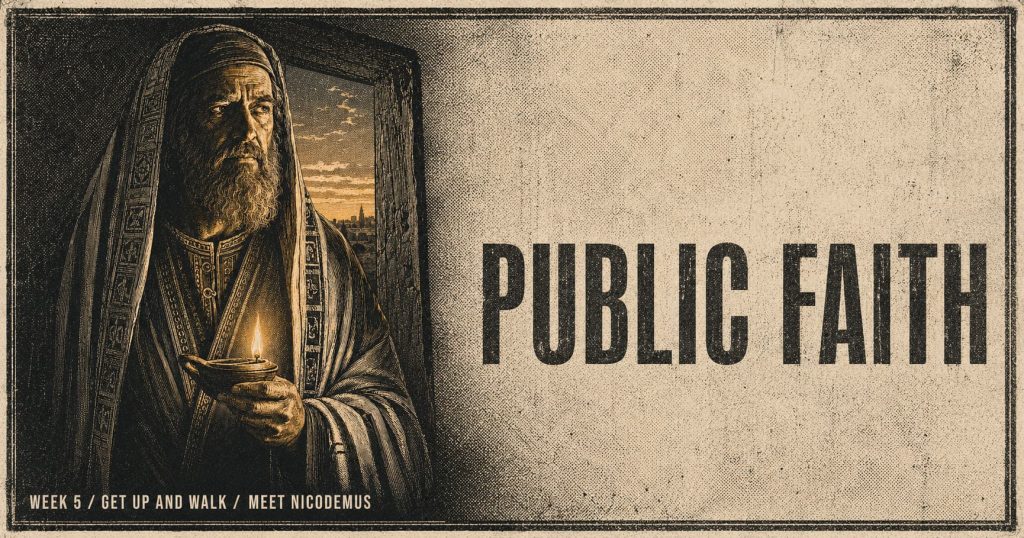
Get Up and Walk · Week 5 · Sunday
Meet Nicodemus
Nicodemus had everything to lose.
He was a Pharisee and a member of the Sanhedrin, the ruling council. He was respected, established, careful, the kind of man who had spent a lifetime building a reputation among exactly the people who would destroy a man for following Jesus. And he was drawn to Jesus. But he could not afford to be seen. So he came at night.
He came at night.
John never lets you forget the detail. He mentions it three times across his Gospel. Nicodemus is the man who came in the dark, and in John’s Gospel, where light and darkness are the whole drama, that is not a throwaway line. It is the diagnosis.
Born of the Wind
That night Jesus tells him he must be born anōthen. It is a Greek word with two meanings at once: “again” and “from above.” Nicodemus hears only the earthly one and is baffled. How can a man be born when he is old? Jesus means the heavenly one. You must be born from above.
Then Jesus says the thing that governs this whole week.
The Greek word pneuma means both “wind” and “Spirit.” Jesus is making a pun Nicodemus would have felt. The Spirit, like the wind, cannot be commanded. You cannot point it, force it, or schedule it. You cannot argue someone into being born from above any more than you can order the wind to blow. This is the theological bedrock under everything we will say this week: you cannot force the new birth in anyone, not your wife, not your kids, not your father, not your friend. You can only live in the wind and pray it blows.
From Night to Daylight
Nicodemus appears two more times in John. In chapter 7, when the council is moving to seize Jesus, he speaks up, but carefully, a procedural question about whether the law condemns a man without a hearing. They sneer at him. It is a half-step into the light, followed by a flinch back into the crowd.
And then the final time. After the crucifixion, when the loud disciples have scattered and gone into hiding behind locked doors, Nicodemus comes out into broad daylight.
Seventy-five pounds. A kingly amount, the kind you would use to bury royalty. He carried it through the streets in the open to claim and bury the body of a man his own council had just executed. By handling a corpse he made himself ceremonially unclean for the Passover. By claiming this body he marked himself publicly, permanently, as one of them. He gave no speech. He won no argument. He simply performed an act of devotion so costly and so public that no one could miss whose side he was finally on.
Came by night. Spoke up hedging. Buried him in the open. That is a man getting up and walking, across three years, out of the dark.
The Silent Soldiers
This week, the finale of our series, we sit with the silent soldiers. The ones quietly fighting a spiritual war for the people under their own roof.
Paul told Timothy to “share in suffering as a good soldier of Christ Jesus.” And he named the real enemy plainly:
The grandmother who has prayed for the family by name for forty years is a soldier in that war. The father who reads, prays, and speaks blessing over his children every single morning is a soldier in that war. They are not loud. They do not corner people. They do not argue anyone into the kingdom, because they know the wind blows where it wishes and the Spirit cannot be forced. They want their families closer to God more than they want anything. And they have learned the hardest discipline of the silent soldier: you cannot push. You can only inspire, and pray, and live it where they can see.
Live it in the open; God does the drawing.
Tomorrow · Won Without a Word
Leave a Reply