
Get Up and Walk · Week 3 · Thursday
Feed My Sheep
He stopped praying about seven years ago.
It was not a dramatic break. Nothing happened to him to make him angry at God. He did not have a deconstruction moment. He did not write the angry letter. He did not get hurt by a church and walk out. He just stopped. Got busy. Got tired. Got a little cynical about the church he had been part of. Stopped reading his Bible. Stopped praying out loud. Stopped praying at all.
He just stopped.
He still believed. Mostly. Probably. He was not sure how to talk about it anymore. He went to church on Christmas and Easter and his sons’ baptisms. He bowed his head politely when his wife prayed at the dinner table. He had not put a Bible verse in front of his own eyes in years. He had not asked God for anything in years. He had not said thank you for anything in years.
His faith had gotten quieter, and then dimmer, and then nearly silent. It was less a leaving than a slow fading out of a room he had stopped showing up to.
This Morning
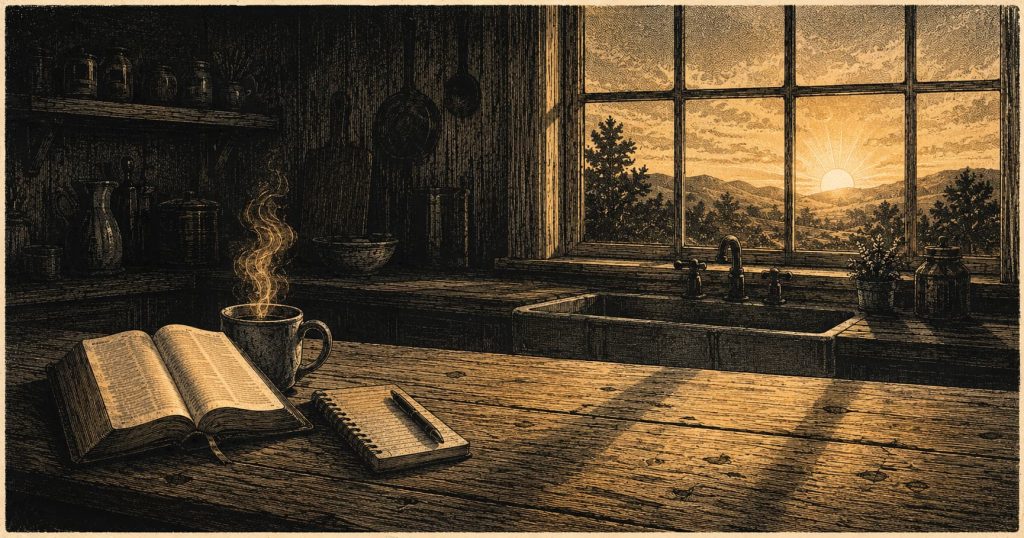
This morning, for reasons he cannot explain, he gets up at five thirty. Earlier than he needs to. The house is dark. The kids are still asleep. He makes coffee. He stands at the counter for a few minutes looking at the dawn coming up through the kitchen window.
And then, without quite deciding to, he walks to the bookshelf and pulls his old Bible down. The one from college. The leather is cracked along the spine. There is a coffee stain on the bottom edge from years ago. He carries it back to the kitchen counter and sits down with his coffee.
He opens it.
He picks a passage he has read a hundred times. The breakfast on the beach in John 21. Jesus on the shore in the early morning, the charcoal fire he had built, fish cooking, the disciples coming in from the water. Peter, who had denied Jesus three times around another charcoal fire days earlier, sitting across from Jesus on the sand. Jesus asking him three times, “Do you love me.”
Biblical Backdrop
The conversation in John 21 has been read in pulpits for two thousand years. Scholars argue about whether the wordplay between the Greek agapaō (a higher love) and phileō (brotherly love) is theologically significant or just literary variation. Mounce and others have shown the question is not as simple as the sermons suggest. What is clear is the structure. Three denials around one charcoal fire. Three questions and three answers around another charcoal fire. The threefold structure is the restoration.
And then, three times in a row, Jesus does not give Peter an absolution. He gives him a job.
Feed my sheep. Not “you are forgiven” (though he was). Not “I trust you again” (though he did). Not “let’s never speak of this again.” Just a job. A mission. A second sending.
This is the Peter who, years later, would become the father figure to the young man named John Mark, the man who had quit his own first mission. Peter learned restoration on a beach in front of a charcoal fire, and then he spent the rest of his life teaching it to a young man named Mark.
What Cracked Open
The man at the kitchen counter reads “Feed my sheep” and something cracks open in his chest. He does not know how to describe it later. He has read the verse before. He knows the wordplay. He knows the threefold structure. None of that is new to him.
What is new is that the verse this morning is not about Peter. It is about him.
Jesus did not ask Peter to be more confident. Jesus did not ask Peter to feel forgiven. Jesus did not ask Peter to perform a more emotional restoration. Jesus gave Peter a job. The job was the restoration. The mission was the absolution.
For seven years, the man at the counter has been waiting to feel something. He has been waiting for the faith feelings to come back before he picked up the Bible. Waiting for the desire to pray to return before he prayed. Waiting for the certainty to return before he did anything that required certainty.
This morning he sees what he has been doing wrong.
He sits at the counter and prays out loud for the first time in seven years. Not a polished prayer. Not a complete one. Just one sentence.
“I am back if you want me.”
His coffee gets cold while he sits with that. He does not feel different. Nothing dramatic happens. The kitchen is the same kitchen.
But he knows he is back at the table. The failure was not the final word.
Tomorrow · The Chair Pulled Up
Leave a Reply