
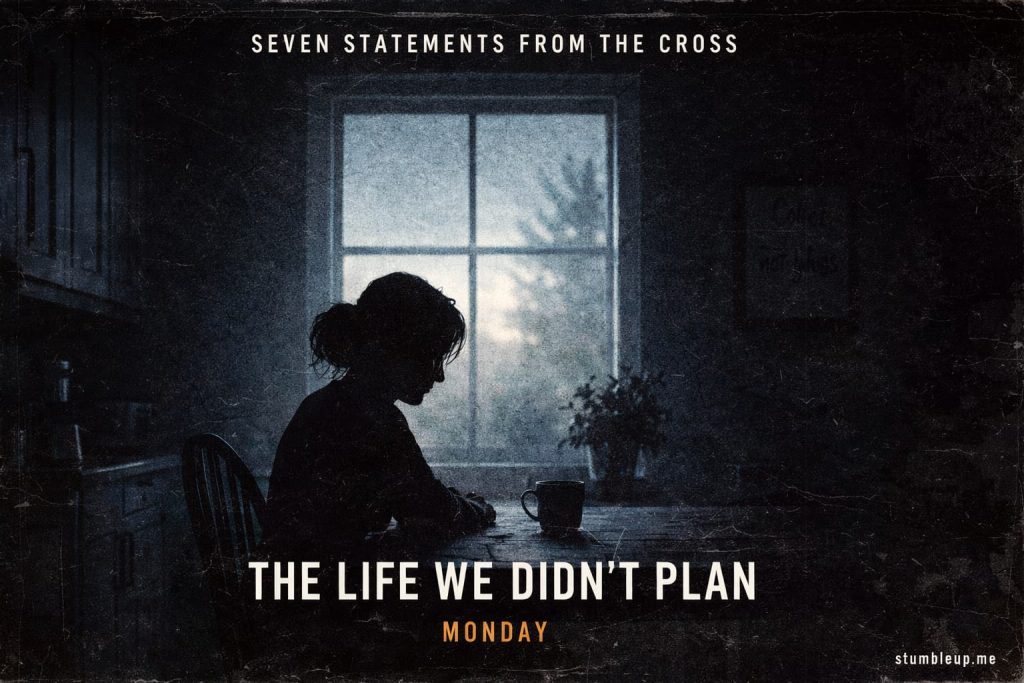
Seven Statements from the Cross • Week 4 • Monday
Statement IV • Matthew 27:45-46 • Renee, early 40s, wife and caregiver
The Setup
Renee is in her early 40s. Her husband was diagnosed with a degenerative illness three years ago. He is still home, still present, still the man she married. But the life they had been building together, the plans they had made, the things they had been working toward, quietly dissolved in the months after the diagnosis. The partnership shifted. The future they had imagined together was replaced by a different future, one that looked a lot more like caregiving than the life either of them had chosen. Renee shows up every day. She has not wavered. And she has never told a single person what it has cost her.
The Crossroads Moment
What lives in Renee’s chest is something she is ashamed to name. It is not resentment toward her husband. She knows that clearly enough. It is grief for the version of their life that is gone, the one she planned, the one she was promised, the one she watched quietly close when no one was looking. The problem is that grief needs somewhere to go. And because she cannot say it out loud to her husband without feeling like she is adding to his burden, and cannot say it to friends without feeling disloyal, it has nowhere to go. So it sits. And over two years of sitting, it has begun to slowly change how she occupies the same room as the man she loves. The distance is subtle. She is the only one who knows it is there. And she does not know how much longer she can carry it without it becoming something she cannot take back.
What Jesus Did
From the cross, Jesus cried out with a question that had no human answer. “My God, my God, why have you forsaken me?” He did not aim it at the soldiers. He did not aim it at the crowd or the disciples or the religious leaders. He aimed it at God, directly, loudly, without softening it into something more acceptable. The Psalms are full of this. Psalm 55:22 says to cast the burden on the Lord, not because God will explain it, but because he will sustain us through it. The burden Renee is carrying is real. The grief is legitimate. The question is not whether she is allowed to feel it. The question is where she is sending it.
The Choice and Outcome
One night after her husband is asleep, Renee sits in the kitchen in the dark and says something she has never said out loud: “God, I am grieving the life we were supposed to have. I am angry that it changed without my consent. I do not know what to do with that and I have been carrying it alone for two years.” She does not hear an answer. The kitchen stays quiet. But something in her chest loosens slightly, not because the grief is gone, but because it finally has an address that can hold it. Over the following weeks she finds a counselor who helps her name what she has been carrying. She starts to grieve the lost future properly, with God as the foundation under it, instead of silently inside a marriage that does not know it is being asked to carry the weight. Her husband notices something in her that has softened without him understanding why. The distance she had been building without meaning to begins to close.
The Lesson
The flesh keeps the hardest grief quiet and lets it change us from the inside out. The Spirit takes it to the only address that can hold it without breaking. Aim your hard questions at God, not at the people who love us but were never built to carry what only he can sustain.
stumbleup.me • #StumbleUp • #SevenStatements • #AimUpward
Leave a Reply