
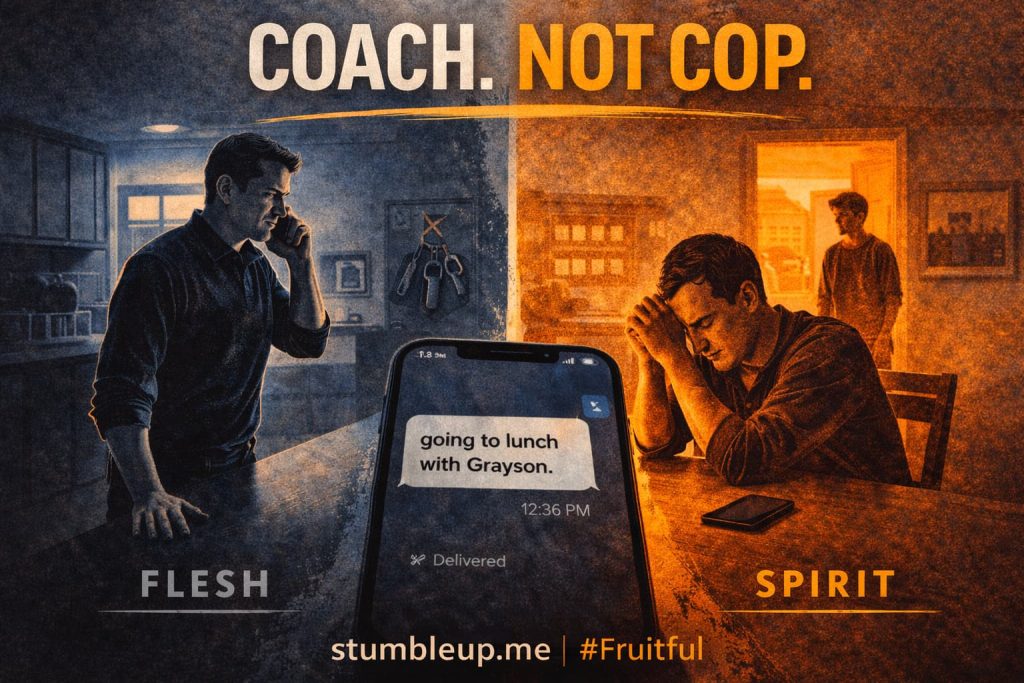
COACH.
NOT COP.
There is a moment in parenting a teenager when everything you thought you believed about discipline gets tested. Not by a small infraction. By a real lie. A deliberate one. The kind where your kid looked you in the eyes and chose to deceive you, and you find out later, and the rage that rises is not just about the behavior; it is about the betrayal.
That is the moment that reveals what kind of father you actually are. Not the version you present on Sunday mornings. The one that shows up in a kitchen on a Tuesday afternoon with his jaw clenched and his hands looking for something to do with the anger.
This is Tyler’s moment. And how he handles it will shape not just Asher’s next six months, but the next six years of their relationship.
And here is the part of this story that deserves to be celebrated before we get into the mechanics of it: Tyler called his dad. He was angry, confused, and looking for backup, but he picked up the phone and called the man who raised him. That act alone tells you something about what Tyler’s father built. And then his dad, rather than simply validating Tyler’s anger, offered him something more valuable than agreement. He offered him wisdom he had paid for the hard way. That is three generations of men, connected in a moment of crisis, doing something countercultural and beautiful: the older man coaching the younger man on how to coach his own son. That chain does not happen by accident. It is the fruit of decades of relationship, and if you still have that kind of father in your life, do not take a single conversation with him for granted.
“Fathers, do not provoke your children to anger, but bring them up in the discipline and instruction of the Lord.”
Ephesians 6:4 · ESV
Discipline That Builds vs. Discipline That Breaks
Ephesians 6:4 is one of the most important verses a father of teenagers can carry. Paul gives two commands in one sentence: do not provoke your children to anger, and bring them up in the discipline and instruction of the Lord. Most Christian fathers do the second part. The first part is where we get into trouble.
The Greek word translated “provoke” is “parorgizo,” meaning to rouse to wrath, to exasperate. It is a word about accumulation; the cumulative effect of an approach that, even when individually justified, becomes something the child cannot carry. Paul is not saying don’t discipline. He is saying be self-aware enough to recognize when your discipline is producing something other than what you intend.
The word for “discipline” he uses is “paideia,” which in the Greco-Roman world described the comprehensive formation of a young person toward full maturity. It was the work of a teacher, a trainer, a coach; not a punisher. It included correction, yes, but correction in service of a larger goal: a fully formed human being capable of governing himself. The rod and the staff in Psalm 23 are shepherd’s tools, not weapons. The rod guided sheep away from danger. The staff pulled them back when they strayed. Both were acts of care aimed at keeping the sheep alive and moving in the right direction.
“For the moment all discipline seems painful rather than pleasant, but later it yields the peaceful fruit of righteousness to those who have been trained by it.”
Hebrews 12:11 · ESV
The writer of Hebrews frames discipline not as a punishment event but as a training season. The goal is always the fruit, not the pain. Pain may be part of the process, but pain for its own sake is not discipline; it is just pain. A father operating in the flesh delivers consequences in anger and calls it discipline. A father operating in the Spirit delivers consequences with a clear eye toward what he is building in his son and what he is preserving in the relationship between them.
Proverbs 29:17 says, “Discipline your son, and he will give you rest; he will give delight to your heart.” The Hebrew word for discipline here is “yasar,” meaning to chastise, to instruct, to correct with a purpose. The promised outcome is not a compliant child. It is a relationship that gives rest; a son who becomes someone his father delights in, not someone his father is perpetually managing.
The lie Asher told is real and it matters. But the question underneath the lie is also real: why did he feel like he had to? A son who is afraid of his father tells fewer truths. A son who respects and trusts his father brings him the hard things. Building the second kind of relationship is not softness. It is the harder, longer, more important work.
“Be a coach, not a cop. He is sixteen. The kind of discipline you are thinking about right now will win the battle and lose the war.”
A Father’s Counsel to His Son
The Accidental Pharisee in a Father’s Anger
The accidental Pharisee shows up in parenting most clearly in moments of moral failure. When a child lies, cheats, sneaks around, or deliberately violates a clearly stated boundary, the religious father has all the theological justification he needs to come down hard. He is right about the behavior. He is right that lying is serious. He is right that consequences matter. And he can do all of that correctly and still lose his son in the process.
The Pharisees were right about the law too. That was never the question. The question was always what the law was in service of, and whether the people applying it had the heart of the Lawgiver or just the letter of the law. Jesus said the entire law hangs on two commands: love God and love your neighbor. Every form of correction, discipline, and consequence we bring to our kids should be traceable back to both of those. If it can’t be, we are operating from flesh, not from Spirit.
Tyler’s father said something that landed harder than any lecture could have: I know I was strict about lying. And I’m telling you what I learned from that. That sentence carries decades of hard-won wisdom. It does not minimize the lie. It redirects the focus from winning the moment to winning the man. There is a version of Tyler that wins this argument with Asher completely and loses his son’s trust for years. And there is a version that addresses the lie with full seriousness, absorbs the discomfort of not going to the full extent of his anger, and builds something in Asher that lasts.
“A soft answer turns away wrath, but a harsh word stirs up anger. The tongue of the wise commends knowledge, but the mouths of fools pour out folly.”
Proverbs 15:1-2 · ESV
Solomon is not describing weakness here. A soft answer requires more self-control than a harsh one. The man who can choose his words deliberately in the heat of genuine anger is operating from a deep well of Spirit-produced self-control; one of the nine fruits of the Spirit listed in Galatians 5. The fool pours out whatever is in him. The wise man chooses what to release and what to hold, not because he feels less, but because he knows what he is building.
THREE GENERATIONS IN ONE PHONE CALL
Think about what actually happened when Tyler called his dad. Asher is 16, learning what kind of man he wants to be. Tyler is in his forties, learning what kind of father he wants to be. And Tyler’s dad, who was by his own admission the strict one, who made the hard calls Tyler is now tempted to make, is calling back across decades of experience and saying: I learned something. Let me save you the cost of learning it the same way.
That is Deuteronomy 6 in real time. Moses told the people of Israel to let the commands of God be on their hearts first, and then to talk of them when you sit in your house, when you walk by the way, when you lie down and when you rise. The transfer of wisdom across generations is not supposed to happen in formal settings. It is supposed to happen in the ordinary and the urgent moments of life together; a phone call from a frustrated father, a grandfather with something worth saying, a conversation that passes something real from one generation to the next.
Psalm 78:4 says, “We will not hide them from their children, but tell to the coming generation the glorious deeds of the Lord, and his might, and the wonders that he has done.” The glorious deeds include the lessons. The hard-won ones. The ones your father paid for so you don’t have to. Tyler’s dad was passing down one of those. Asher, whether he knows it yet or not, is the recipient of wisdom that started two generations before him.
A 16-year-old who lies to his parents is not finished being formed. He is in process. Our job at that stage is not to enforce perfect behavior. It is to stay close enough and credible enough that when he is 24 and faces something genuinely dangerous, he still calls us. That long-game thinking is not weakness. It is wisdom. And it only comes from a father who has let the Spirit get ahead of his anger.
Tyler, Jennifer, and Asher
Tyler and Jennifer have four boys. Asher, 16, is the second one to drive; a milestone they handed him with real intention, because they wanted to build trust, not just manage behavior. Asher has been sneaking off campus at lunch from a school with a clear no-leave policy. When his parents found out, the conversation was direct and the rule was simple: if you go anywhere other than where you are supposed to be, you tell us. They also made clear they would not go to bat for him with the school; those consequences were his to own. Asher agreed. Then one afternoon he texted that he was going to lunch with his friend Grayson. Tyler redirected him. Asher went anyway. And when Tyler followed up, the story unraveled; Asher had not gone with Grayson. He had gone with a girl his parents had already flagged as a bad influence, and he had lied straight to their faces to do it.
THE FLESH RESPONSE
Tyler boils. He calls his dad, expecting backup for what he already knows he wants to do; take the car, hard consequences, full stop. His dad listens, then says something Tyler wasn’t ready for: be a coach, not a cop. Tyler pushes back, points to how strict his dad used to be about lying. His dad says: I know. And I’m telling you what I learned from that.
Tyler doesn’t fully hear it. He goes to Asher in the heat of the anger and unloads. The lie, the girl, the trust, the car, the whole stack. He takes the keys off the hook right there in the kitchen. Asher’s face goes flat. Not broken, not repentant; just closed. Tyler calls it accountability. Asher calls it something else in his head, and that version of the story is the one he carries out of the room.
The behavior is addressed. The relationship takes the damage.
THE OUTCOME
Asher complies for a season because he has to. But something closes between them. He stops volunteering anything he doesn’t have to. He gets better at managing information, not at telling the truth. The next hard thing in Asher’s life, Tyler will be one of the last to know. He won the moment. He is losing the man.
Fruit on Tyler’s tree: A Son Who Complies · A Relationship That Manages · A Door That Gets Narrower Every Year
THE SPIRIT RESPONSE
Tyler hears his dad’s words: coach, not cop. He sits with the anger for an hour before he goes to Asher. He prays, not for Asher specifically, but a simple honest prayer: Lord, let me say what builds something, not just what I feel right now.
He sits down with Asher and leads with a question instead of a verdict: “Walk me through what happened and why you felt like you had to lie to do it.” Asher is braced for the explosion that didn’t come. He talks. Tyler listens longer than it is comfortable to listen. He finds out the girl situation is more complicated than he knew, that Asher is already uncertain about her himself, and that the lie was partly shame about something he already regretted.
The consequence still comes; real, connected to the behavior, clearly explained. The car is restricted for two weeks. The boundary is restated plainly. But before Asher leaves the room Tyler says: “I’m not your cop. I’m your dad. I need you to know those are different things.” Asher doesn’t say much. But he hears it.
THE OUTCOME
Six months later Asher comes to Tyler with something he could have kept hidden. He doesn’t. He brings it before it becomes a problem because somewhere in that kitchen conversation he learned that coming to his dad is not the same as walking into a courtroom. That choice, that one unprompted honest conversation, is worth more than a hundred consequences delivered in anger.
Fruit on Tyler’s tree: A Son Who Brings Hard Things · A Relationship That Goes Deeper · A Door That Stays Open
You Are Building a Man, Not Managing a Behavior
The lie was real. The consequence was appropriate. None of this is about letting Asher off the hook. It is about what Tyler was actually after. If the goal is a compliant teenager, maximum consequence in maximum anger gets you there in the short term. If the goal is a 25-year-old man who still comes to his father when things go sideways, the approach has to be different. Those two goals require completely different strategies, and a father operating in the flesh doesn’t stop to ask which one he is actually chasing.
Tyler’s father had been the strict one. He remembered that. And now his father was telling him to pull back; not because lying is acceptable, but because he had learned over decades what that approach costs at the other end. That is wisdom passing down a generation. Proverbs 20:7 says, “The righteous who walks in his integrity; blessed are his children after him.” The blessing doesn’t just flow from being right. It flows from the kind of man you become over a lifetime, the kind that your kids and grandkids want to emulate because they have watched it work in real time on them.
CONNECTING TO THE FRUIT: JOY
Joy, as we have defined it, is not happiness. It is the settled confidence that God is in control; the power to hold steady through adversity without being swept away by it. A father operating in the joy of the Spirit does not need to emotionally detonate every time his son fails. He has enough of God’s peace inside him to absorb the blow, feel the real pain of the betrayal, and still respond from his values rather than his nervous system.
That hour Tyler spent sitting with the anger before going to Asher? That was the Spirit doing something. Not suppressing the emotion. Not pretending the lie didn’t matter. Giving him enough room between the feeling and the response to choose what kind of father he actually wants to be. James 1:19 puts it plainly: “Let every person be quick to hear, slow to speak, slow to anger.” That sequence, in that order, is what the Spirit produces in a man who yields to it. It is also what transforms a confrontation into a coaching session.
I have boys the same age as Asher. I know what it feels like to be lied to by someone you gave a key to a car. The anger is real and it is right; lying matters and we should not pretend otherwise. But I have also learned, sometimes the hard way, that the moment my anger becomes the main event, I lose the room. Asher was not watching for whether Tyler was right. He was watching for whether his dad was safe. That is always what they are watching for. And that question is only answered by what Tyler does after he finds out he was lied to, not by whether he knew his Bible verse.
But here is what I want you to sit with if you are a father of sons: Tyler had someone to call. He had a dad who picked up the phone, who had enough humility to say I know I did it differently, and enough wisdom to say here is what I learned from that. That is a gift that not every man has, and if you have it, you need to treat it like the treasure it is. Call him. Ask the hard questions. Let him speak into the moments where your anger is louder than your wisdom. That relationship is one of God’s primary mechanisms for passing faithfulness across generations.
And if your father is gone, or was not the kind of man you could call in a moment like this, then let that be the thing you build for your sons. Be the dad they call when they are forty and boiling and looking for someone who has already paid for the lesson they are about to learn. That is the long arc of faithful fatherhood. Not perfection in any single moment, but a relationship that is still producing fruit two and three generations out. Asher will have sons one day. What Tyler does in that kitchen will echo further than either of them can see right now.
BEFORE YOU CLOSE THIS TAB
Coaching Questions for Today
01 / THE GOAL CHECK
When you discipline your teenager, which outcome are you actually aiming at; a compliant kid in the short term, or a man who still brings you the hard things a decade from now? Is your approach aligned with the goal you say you have?
02 / THE ANGER AUDIT
Think about the last time one of your kids did something that genuinely made you angry. How much time passed between the feeling and your response? Was your child watching a father who had his emotions under authority, or one who was being driven by them?
03 / THE SAFETY QUESTION
When your son lies to you, what is the first question you ask; what did he do, or why did he feel like he had to hide it? The second question is harder and slower. It is also the one that closes the gap instead of widening it.
04 / THE GENERATIONAL WISDOM CHECK
Is there a man in your life; a father, a mentor, someone who has already raised sons to adulthood, whose counsel you trust enough to call when you are boiling? Tyler called his dad. That call changed the outcome. Who is that person for you, and when did you last ask him the hard questions?
05 / THE GENERATIONAL GIFT
If your father is still living, when did you last call him not to update him but to ask him what he learned? Not about logistics; about fatherhood. About the calls he got right and the ones he would make differently. That conversation is available to you. Most men never have it. Don’t be one of them.
CLOSE WITH THIS
Lord, make me a coach, not a cop. When my son looks me in the eyes and lies, help me to feel the weight of that without being controlled by it. Give me the Spirit-produced self-control to respond from my values instead of my nervous system. Remind me what I am actually building here; not a compliant teenager, but a man who still comes to his father when things are hard. Let my discipline be in service of that. And if I still have a father I can call, let me never take that for granted. Let the wisdom he paid for flow through me to my sons, and through them to their sons. That is the chain you build, Lord. Let me be a faithful link in it. Amen.
The flesh wins the moment. The Spirit wins the man.
Stay in step with the Spirit.
Leave a Reply