
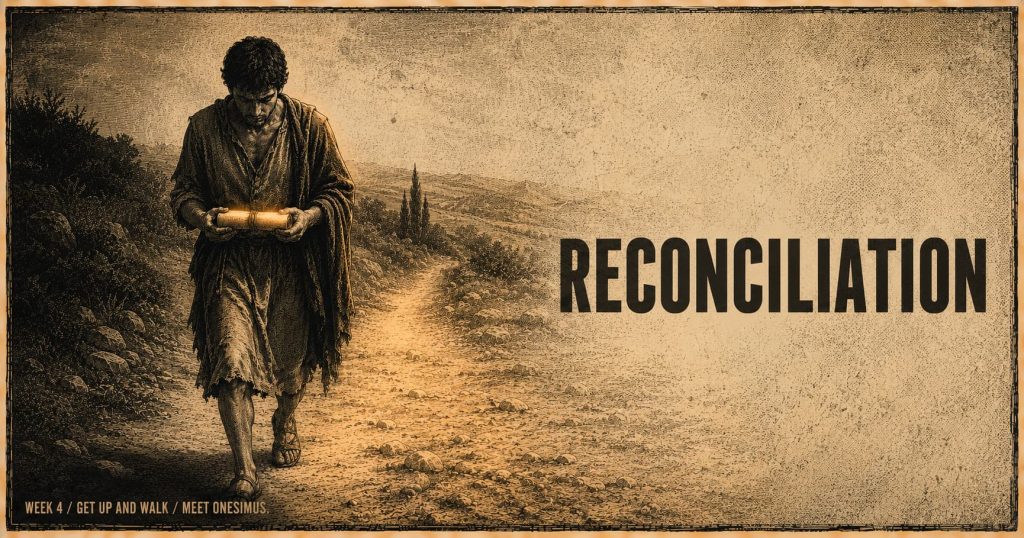
Get Up and Walk · Week 4 · Sunday
Meet Onesimus
Onesimus was a slave. He ran.
We do not know exactly what he took with him when he left. The letter that tells his story hints that he owed his master something, and in the ancient world a runaway slave almost always stole to fund the escape. What we do know is the stakes of what he had done.
He was property that had stolen itself.
Biblical Backdrop
Roman slavery was not the indentured servitude people sometimes imagine. A slave was property under law, with no legal personhood. A runaway slave, a fugitivus, lived under a death sentence that could be carried out at the owner’s discretion. Recaptured runaways were commonly branded on the forehead, sometimes with the letter F for fugitivus, sometimes beaten, sometimes executed as a warning to other slaves. There was no system that would protect Onesimus. He had run from a man who owned him, and by running he had multiplied his crime.
Somehow this runaway crossed paths with the apostle Paul, who was under house arrest in Rome. We are not told how. What we are told is that under Paul’s influence, Onesimus became a follower of Jesus. He became, in Paul’s own language, a son.
Onesimus had become genuinely useful to Paul in prison. Paul says elsewhere he would have been glad to keep him. By every practical measure, the easiest and safest thing for everyone was for Onesimus to stay in Rome, useful to Paul, far from the master he had robbed.
Paul sends him back instead.
The Pun That Carries the Letter
The name Onesimus was a common slave name. It means “useful” or “profitable.” You named a slave the way you named a tool, for what you wanted it to do for you. So when Paul writes about him in verse 11, he is making a pun on the man’s own name.
The Greek says he was achrēstos, useless, but is now euchrēstos, well-useful. A man literally named Useful had lived as the opposite of his name. And now, in Christ, he had finally become what his name had always promised. The slave named Useful was useful at last.
There is one more layer. The Greek word chrēstos (useful) was, in the first century, pronounced almost identically to Christos (Christ). The two words were so close that ancient writers sometimes confused them. Paul, writing this letter, is making a pun three levels deep. Onesimus became euchrēstos, useful, by becoming Christou, Christ’s. The usefulness came from the belonging.
This is the same word, euchrēstos, that Paul would use years later for John Mark in his final letter. “He is very useful to me for ministry.” Paul had a category in his heart for people the world had written off who turned out to be the most useful of all. Onesimus was the first of them.
The Walk Back
Here is what we sometimes miss reading this comfortable, two-thousand-years-later. When Paul sent Onesimus back to Colossae, he was sending a man on a road that could end at a branding iron or worse. Onesimus had to carry the letter himself. He had to walk back into the household he had robbed and fled. He had to stand in front of the master he had wronged and wait to see what that master would do.
He did not have to. He could have stayed in Rome. He chose the walk back.
That is the whole of reconciliation in one man’s feet on a road. Not a feeling. Not a wish that things were better. Not a vague hope that time would heal it. An actual walk, back toward the person you wronged, with no guarantee of how it ends.
The Theme of the Week
Most of us have an Onesimus road we have refused to walk.
A person we wronged and never went back to. A wound we caused in a marriage and papered over instead of naming. A son we lost our temper with and never circled back to. A colleague we let take a fall that was partly ours. A brother we have not spoken to in years. A reconciliation we have been worshipping around for so long we have stopped noticing we are doing it.
Onesimus picked up the letter and walked. The walk back is the work.
Tomorrow · The Letter on the Counter
Leave a Reply