
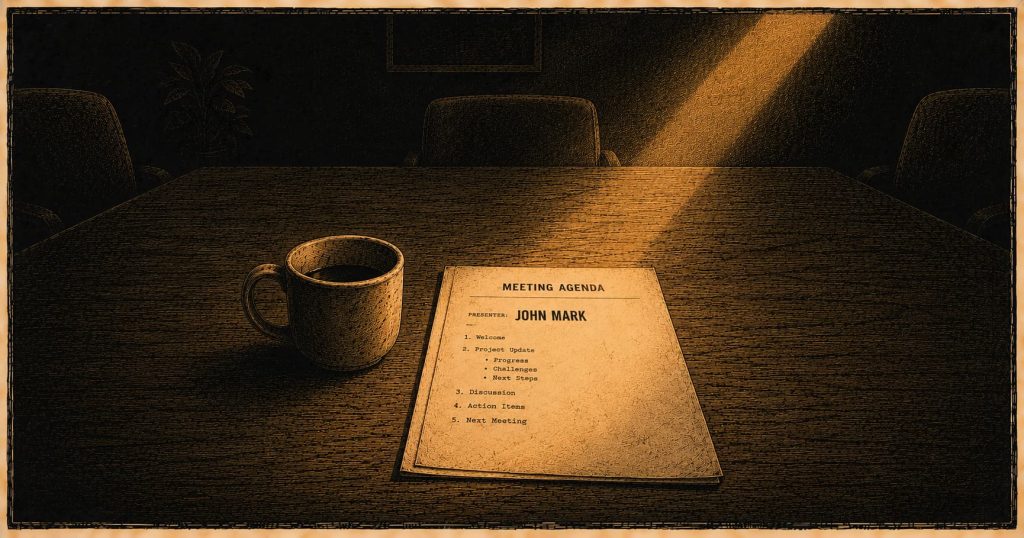
Get Up and Walk · Week 3 · Wednesday
The Cousin Who Vouched
He fumbled a major presentation a year ago.
In front of leadership. The kind of meeting that decides which projects get funded for the next year. He had prepped for weeks. He had the deck memorized. He had run it past three peers. He felt as ready as a man could be the night before.
When he stood up he froze on the third slide. A senior leader asked a sharp clarifying question and his mind went white. He stammered through the next ten minutes. He fumbled the closing questions. He could feel the room writing him off in real time, the way a room you cannot win does, where the eyes that were on you slowly drift back to laptops and phones.
He could feel the room writing him off in real time.
He went home that night and sat in his car in the driveway for forty minutes before he could go in and tell his wife what had happened.
The Year of Smaller Rooms
He spent the year quietly rebuilding. Took the smaller assignments. Delivered them well. Stopped putting himself forward for the visible work. Stopped raising his hand in the meetings where there was something to be won. Made peace with the idea that the big-meeting career was probably over for him, that he would settle into the role of the reliable middle, that the leadership track was probably closed.
His wife did not push him. His manager did not push him. He just slid quietly into a smaller version of his own career, and he was not sure if he was disappointed or relieved.
The Email
Tuesday morning he got an email from a colleague three offices down. A senior leader, but not his manager. The colleague had been in the room a year ago when he had frozen. They had not talked about it in the months since. Just the same hallway nods, the same standup meetings, no special acknowledgment either way.
The email was three sentences.
“I put your name forward for the Q3 readout. I think you have a better story to tell now than you did last year. I will be in the room. Say yes.”
He stared at it for ten minutes.
The colleague had no reason to do this. There was no upside for the colleague. If he froze again at the Q3 readout, it would partly be on the colleague who had vouched for him. The colleague was spending some of their credibility to give him a second mission, and the spending was entirely a gift.
He said yes.
Biblical Backdrop
When Paul refused to take John Mark on the second missionary trip, Barnabas did not just disagree. He spent his credibility.
The Greek for “sharp disagreement” is paroxysmos. Where English gets “paroxysm.” It is the same root as the medical term for a sudden violent attack of a condition. It is a strong word. Paul and Barnabas had been a team for over a decade. They had argued in front of the Jerusalem council. They had been beaten and stoned together. They had been the team. And the two of them had a paroxysm over whether John Mark deserved a second mission, and they ended their partnership over it.
Barnabas paid for that vouching. He lost his partnership with the most consequential apostle in the early church. He disappears from the book of Acts after Acts 15:39. The biblical record of Barnabas effectively ends with the verse where he chose to spend his credibility on a young man who had failed.
But here is the math. The man Barnabas vouched for went on to write the Gospel of Mark. The man Paul refused became the man Paul, years later, asked for from his prison cell. “Get Mark and bring him with you, for he is very useful to me for ministry.” Barnabas’s bet paid off. Just not in time for Barnabas to read about it.
The Workplace Story Behind the Story
Most of us, at some point in a career, will have a year of smaller rooms. A presentation we choked. A project we managed badly. A meeting where we lost the room. We will spend a year quietly trying to rebuild. We will mostly do it alone.
And then, if we are very lucky, somebody three offices down will spend some of their credibility on us.
That is the Barnabas move. That is the cousin who vouched. It is also the thing we get to do for somebody else when we have the credibility to spend. Watch for the man or woman in your hallway who is quietly rebuilding after a public failure a year ago. Spend some of your credibility on them. Put their name in the email. Sit in the room when they present.
You may pay for it. Barnabas did. But the man you vouched for may write a Gospel.
The failure was not the final word.
Tomorrow · Feed My Sheep
Leave a Reply