
Get Up and Walk · Week 1 · Monday
The Workshop
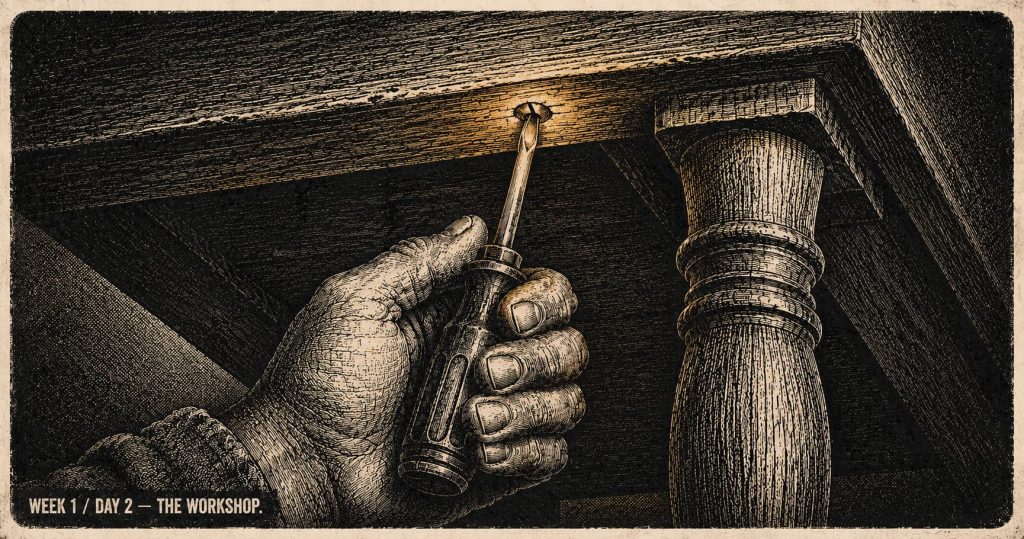
He stands in the garage with a screwdriver in his hand. His wife asked him after dinner to look at the wobble in the kitchen table. He told her “yeah, I got it” the way most of us tell our wives we’ve got it when we don’t actually got it.
The screwdriver feels older than he is. The voice in his head is older still.
“You’re going to mess this up. You always do.”
That voice has worn a path through his brain since he was eight years old, sitting on a paint can, watching his own father start a project and not come back to finish it. He grew up learning what kind of man finishes things by watching a man who didn’t. You can grow up doing that and not know you’re being trained. You think the voice is just you.
It’s not.
What’s Underneath
This is what identity does. It hands you a script. Before you’ve picked up the screwdriver, your script tells you how the scene ends. You quit. You call somebody. You walk back inside and tell your wife it’s a bigger problem than you thought.
The voice telling a man he is about to fail is not the voice of God. It is not even his own voice. It is the voice of an older story he picked up at eight and never put down.
Mephibosheth understood this. He spent his whole adult life in a town called Lo-debar, which means “no pasture,” and he called himself a dead dog before the king. He had a script too. The fall when he was five wrote it. The fact that he was the last living heir of a hated former king reinforced it. By the time David tracked him down, the dead-dog story was the only story he could tell about himself.
Then the king said this:
The king didn’t dispute Mephibosheth’s story by arguing with it. He didn’t say, “you’re wrong about yourself.” He just pulled out a chair.
Back in the Garage
He kneels down under the table. Tightens the screw. Checks the next leg. Spends twenty minutes on what probably needed five. The table stops wobbling. His wife sets it for breakfast and says thanks without making a thing of it.
It was never about the table.
He went to the workshop as a man whose seat at the King’s table is already set. Not as the boy whose dad never came back to finish. The old voice loses its grip the moment we act on the truer story.
The dead dog gets up and walks because the King already pulled out the chair.
Tomorrow · What He Said in the Driveway
Leave a Reply