
Get Up and Walk · Week 1 · Sunday
Meet Mephibosheth
We are off to a new exploration. In my readings over the past few weeks, I have noticed some obscure characters in the Bible. I thought we would focus on one for the whole week and rotate. The famous ones (David, Paul, etc…carry lots of sermon baggage some times). So here we go. Most of us know David. Almost none of us know the kid he saved.
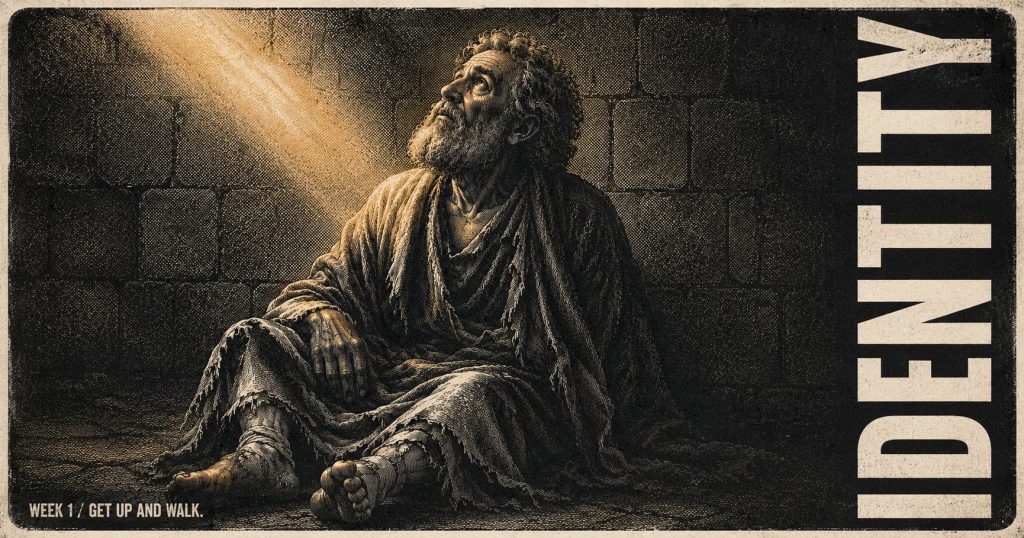
His name was Mephibosheth. He was five years old when his father Jonathan and grandfather King Saul both died on the same day. His nurse heard the news, scooped him up, and ran. In the panic, she dropped him. He was lame in both feet for the rest of his life.
By the time we meet him as a grown man, he is hiding in a place called Lo-debar. The Hebrew name means “no pasture.” A wilderness of nothing. He is married. He has a son. He is also forgotten by his nation, by the new king, and by his own story.
Biblical Backdrop
The boy’s birth name was Merib-baal, meaning “contender of the lord.” The biblical writers later scrubbed the Baal reference and replaced it with bosheth, the Hebrew word for shame. So the name we read in our Bibles, the name he carries through the rest of his life, literally translates to “from the mouth of shame.”
His house name was shame. His hometown name was nothing. His self-description, when he finally meets the king, will be the lowest thing in his culture: a dead dog.
Then a messenger arrives in Lo-debar. The new king of Israel is asking after him by name. He is loaded into a cart and brought to Jerusalem. He limps into the throne room. And David, the king who could have killed him as a rival heir to Saul’s throne, says this:
Watch what David does not say. He does not say, “if you clean up.” He does not say, “let’s see what you can offer.” He does not even mention Mephibosheth’s name in the reasoning. The kindness is for Jonathan’s sake. Because of a covenant David made years before, when Mephibosheth was barely walking.
The next thing the man with the shame-name says is the most honest sentence many of us have ever read in the Bible:
Most of us have said something like that to ourselves at three in the morning.
The Theme of the Week
For the rest of his life, Mephibosheth ate at David’s table. Scripture goes out of its way to tell us he was “like one of the king’s sons” (2 Samuel 9:11 ESV) and ends his story with a short, devastating line: “So Mephibosheth lived in Jerusalem, for he ate always at the king’s table. Now he was lame in both his feet” (2 Samuel 9:13 ESV).
Did you catch that last sentence? After everything. After the table, after the inheritance, after the place “like one of the king’s sons.” The Bible reminds us he was still lame.
The limp stays. The seat stays.
Because that’s the truth of identity for every man at this table. We are still lame. We still carry the limp of the day we were dropped. We still wake up some mornings convinced we are a dead dog. And the table is still ours.
This week we follow five very normal moments in a married father’s life where the old voice tries to define him, and where the covenant of a King who already pulled out his chair quietly wins.
We do not earn the seat. We come to it.
Tomorrow · The Workshop
Leave a Reply