
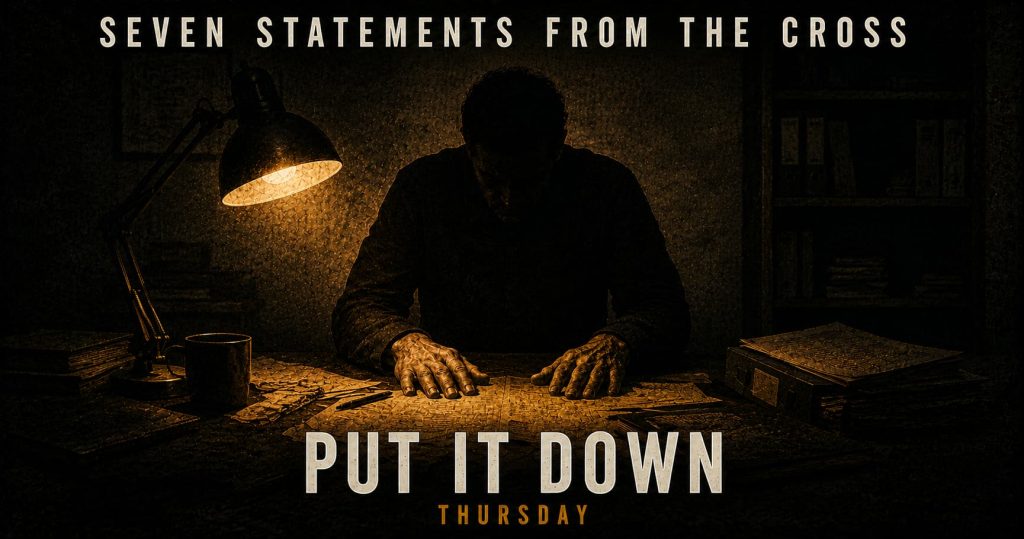
Seven Statements from the Cross • Week 7 • Thursday
Statement VII • Luke 23:46 • Paul, early 50s, husband
The Setup
Paul is in his early 50s. Three years ago, during a season where he was trying to build something for his family’s future, he made a series of decisions that unraveled badly. He was not careless and he was not hiding anything. He was a man who looked at the information available to him, made the best calls he knew how to make, and watched them go wrong in ways that cost his family in real and lasting ways. The kind of financial loss that changes what is possible for a while. The kind that requires difficult conversations and adjusted expectations and a period of genuine hardship that the people he loved most had to walk through because of choices he made.
His wife told him clearly and more than once that she did not blame him. His family rebuilt. The finances have recovered to a degree that no longer requires daily crisis management. By every measure that another person looking at his life could apply, they have come through it. What those external measures do not capture is the weight Paul carries in a private interior place that has not lightened in three years. He performs recovery. He shows up and functions and does not burden anyone with what he is still carrying. He is, by all appearances, fine. He is not fine. He is a man who cannot forgive himself for something that grace already covered, and the inability to receive what has already been given is its own kind of prison.
The Crossroads Moment
The particular cruelty of what Paul is carrying is that the people around him have moved on and he cannot. His wife has forgiven him completely and loves him without reservation. His family does not hold it against him. God covered it at the cross, which Paul knows theologically in a way that has not yet become true in his body. He is living as a condemned man in a sentence that was already overturned, and the weight of that self-imposed condemnation is slowly shaping him into someone smaller than he was before the failure and smaller than he is supposed to be. He has not been able to figure out how to put it down because putting it down feels like minimizing what it cost his family, and some part of him believes that carrying it is the appropriate penance for what he did. It is not penance. It is self-punishment wearing the mask of responsibility.
What Jesus Did
Jesus said it is finished in Statement Six, and into your hands I commit my spirit in Statement Seven, and those two statements are inseparable. The finished work of the cross is the ground beneath the surrender. Jesus could place his spirit into the Father’s hands because the debt was paid. Romans 8:1 does not say there is now reduced condemnation or manageable condemnation for those in Christ Jesus. It says no condemnation. None. The thing Paul cost his family was real. The grace that covered it is also real. Both things are true. And the work of Statement Seven is not just surrendering the future. It is surrendering the past, putting down the weight of what has already been paid for and trusting that the hands he is placing it in are large enough to hold it without requiring him to carry it alongside them.
The Choice and Outcome
Paul is reading Romans 8 early one morning, not for the first time, but for the first time in a while with enough quiet around him to actually hear it. He gets to verse 1 and stops. He sits with it for a long time. Then he prays something that is more honest than anything he has prayed in three years: I cannot carry this anymore. I know what it cost. I know you know what it cost. I am putting it down. I am trusting that the grace that covers everything else covers this too. He does not feel instantly lighter. The prayer does not produce a dramatic sensation of release. But something shifts in him over the following weeks that the people closest to him begin to notice. He is more present. Less defended. The performed version of recovery begins to be replaced by something that looks more like actual recovery. The weight is not gone. But he is no longer the one carrying it alone.
The Lesson
The flesh carries what grace already covered because it confuses self-punishment with responsibility. The Spirit receives what has already been given and puts down what was never meant to be carried indefinitely. The thing we cannot forgive ourselves for is the exact thing grace was built to hold. Surrender your life to God and let it go, including the chapters that already ended badly.
stumbleup.me • #StumbleUp • #SevenStatements • #OpenHands
Leave a Reply