
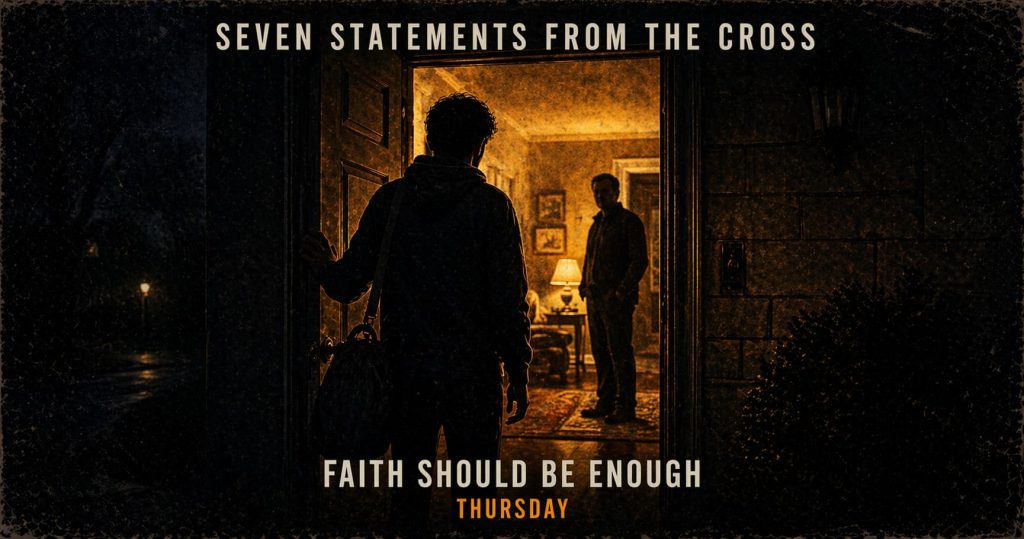
Seven Statements from the Cross • Week 5 • Thursday
Statement V • John 19:28 • Caleb, 24, young adult
The Setup
Caleb is 24, one year out of college. The anxiety started quietly in the months after graduation, a formless dread that does not attach itself to any specific thing but makes ordinary situations feel like too much. Crowded rooms. New conversations. The Sunday morning drive to church. He knows what he believes. He prays. He reads Scripture. He trusts God in the way a man who was raised right trusts God. And he is deeply ashamed that none of that seems to be enough to make the anxiety stop. He has constructed a theology of his own failure from this, the idea that a man with real faith should not need help beyond prayer, that asking for more is an admission that his faith is insufficient. So he tells no one and prays harder and the anxiety does not go anywhere.
The Crossroads Moment
His dad is the specific person Caleb cannot tell. His dad is a man who handled hard things without complaint for his entire life, who showed up, who did not make weakness visible, who Caleb has been consciously or unconsciously trying to become since he was twelve years old. Asking for help in front of his dad feels like handing his father evidence that something did not take. He imagines the conversation and in the version in his head his dad looks at him differently afterward, with a kind of quiet recalibration of who he thought his son was. That imagined look is the thing keeping the door closed more than anything else. So he comes home on weekends and performs fine, and his dad watches him perform and cannot quite locate what feels slightly wrong.
What Jesus Did
Paul writes in 2 Corinthians 12:9 that God told him directly: my power is made perfect in weakness. Not in spite of weakness. In it. Jesus modeled this from the cross when he said “I thirst” in front of his mother, his closest friend, and a crowd of strangers. He did not let pride prevent him from naming what was true. The power of that moment was not diminished by the need. The need was the moment. Caleb had built a theology that said weakness disqualifies a man from God’s power. Scripture says it is the exact location where God’s power shows up. The thing Caleb was ashamed of was the thing God was waiting to work through.
The Choice and Outcome
His dad notices something on a Saturday visit, not anything specific, just the accumulated weight of a son who is working very hard to seem okay. He waits until they are alone and sits down across from Caleb and says something he has never said before: “You do not have to have this together in front of me. You never did.” Caleb is quiet for a long moment. Then he says the thing he has been carrying for eight months. His dad listens without interrupting. He does not look at his son differently. He leans forward. He tells Caleb about a season in his own life in his 30s that Caleb never knew about, a season where he needed more than prayer and did not know how to ask for it either. He tells Caleb to go talk to someone. He offers to help find the right person. He tells him: acknowledging that you need help is not a failure of faith. Pretending you do not is. Caleb drives home lighter than he has been in eight months. He makes an appointment the following week.
The Lesson
The flesh equates asking for help with weakness because it has confused performance with strength. The Spirit knows that God’s power is made perfect in the weakness we are willing to name out loud. Acknowledging need is not a failure of faith. Sometimes it is the most honest act of faith we have.
stumbleup.me • #StumbleUp • #SevenStatements • #OpenTheDoor
Leave a Reply