
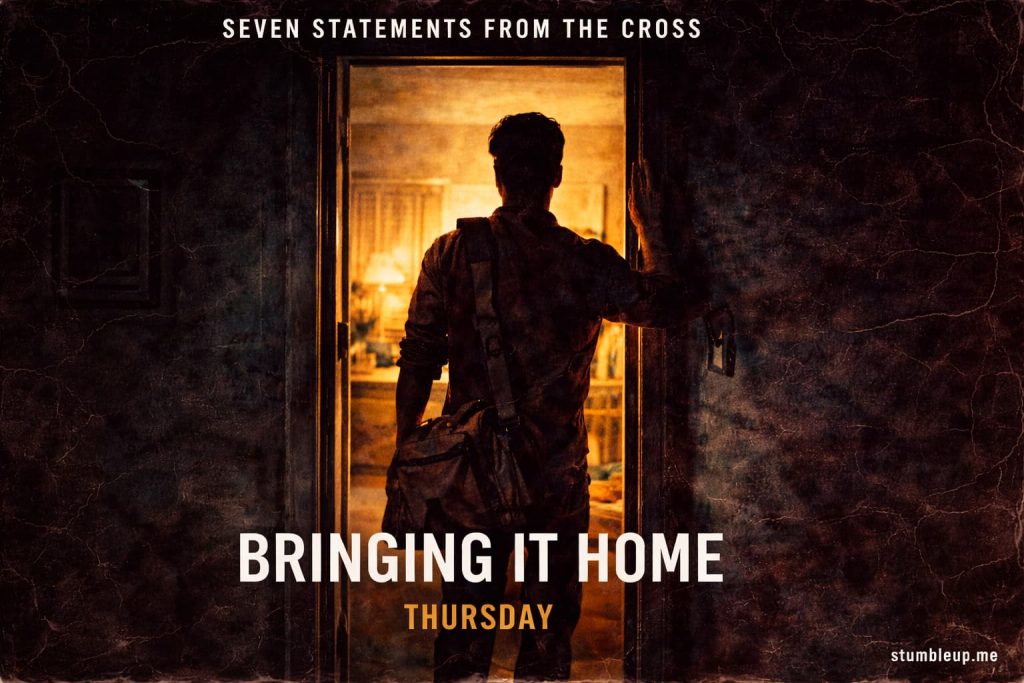
Seven Statements from the Cross • Week 4 • Thursday
Statement IV • Matthew 27:45-46 • Caleb, 19, college freshman
The Setup
Caleb is 19 and one semester into college. He grew up in a home where faith was practiced seriously and Scripture was handled with care. He arrived at school with a framework he had never needed to defend because it had never really been challenged. That changed fast. A professor spent the better part of a month dismantling the intellectual foundations of belief with a precision that Caleb was not equipped to answer and a confidence that made the room feel like the case was already settled. By Thanksgiving break Caleb was not sure what he believed anymore. He had not told anyone. He came home carrying the weight of it and no good language for what it was.
The Crossroads Moment
What was happening at home was not pretty. He was short with his mother in ways that surprised her. He was dismissive of things his dad said that he would have simply nodded through six months earlier. He picked at his younger siblings over things that did not matter. The house felt tense in a way nobody could quite name because nobody knew what was actually wrong. Caleb knew. He was not actually in conflict with his family. He was in conflict with God, with the silence, with the unanswered questions, with the fear that the framework he had built his life on might not hold. But God was not answering, and his family was right there. So they were getting it instead.
What Jesus Did
At the ninth hour, in the darkness, Jesus cried out his hardest question to God. Not to a disciple. Not to his mother standing at the foot of the cross. To God. He took the unanswerable directly to the source. Psalm 56:3 says that when fear comes, we put our trust in God, not because the fear is irrational but because God is the only one who can receive the weight of it without being crushed. Caleb’s doubt was not irrational. His questions were real. The problem was not that he had them. The problem was who was receiving them.
The Choice and Outcome
His dad notices on Saturday evening that the edge in Caleb has not let up the entire visit. He finds a moment when they are alone and says something simple: “I do not think you are actually upset with us. I think something is going on that is bigger than us and we are just easier to reach than whatever it actually is.” Caleb does not respond immediately. They sit with it for a moment. Then it comes out, not all of it, but enough. The professor. The questions. The fear that what he grew up believing might not be true. His dad does not solve the theology. He does not pretend to have answers the professor does not. He says: doubt aimed at God is not the death of faith. It is often where real faith starts. That night Caleb writes out the actual questions, not at his family, not in his head, but directly, on paper, as prayer. He does not get answers. He gets a direction. That turns out to be enough to go back.
The Lesson
The flesh aims its hardest questions at the people in the room because they are visible and God feels distant. The Spirit learns to aim doubt and fear upward, where it becomes the raw material of deeper faith instead of the thing that damages everyone nearby. Doubt aimed outward becomes destruction. Aimed upward, it becomes depth.
stumbleup.me • #StumbleUp • #SevenStatements • #AimUpward
Leave a Reply